Field Notes
ADHD procrastination: what actually helps?
More pressure usually makes avoidance worse. The useful move is making the start smaller, the exit harder, and the next block obvious.
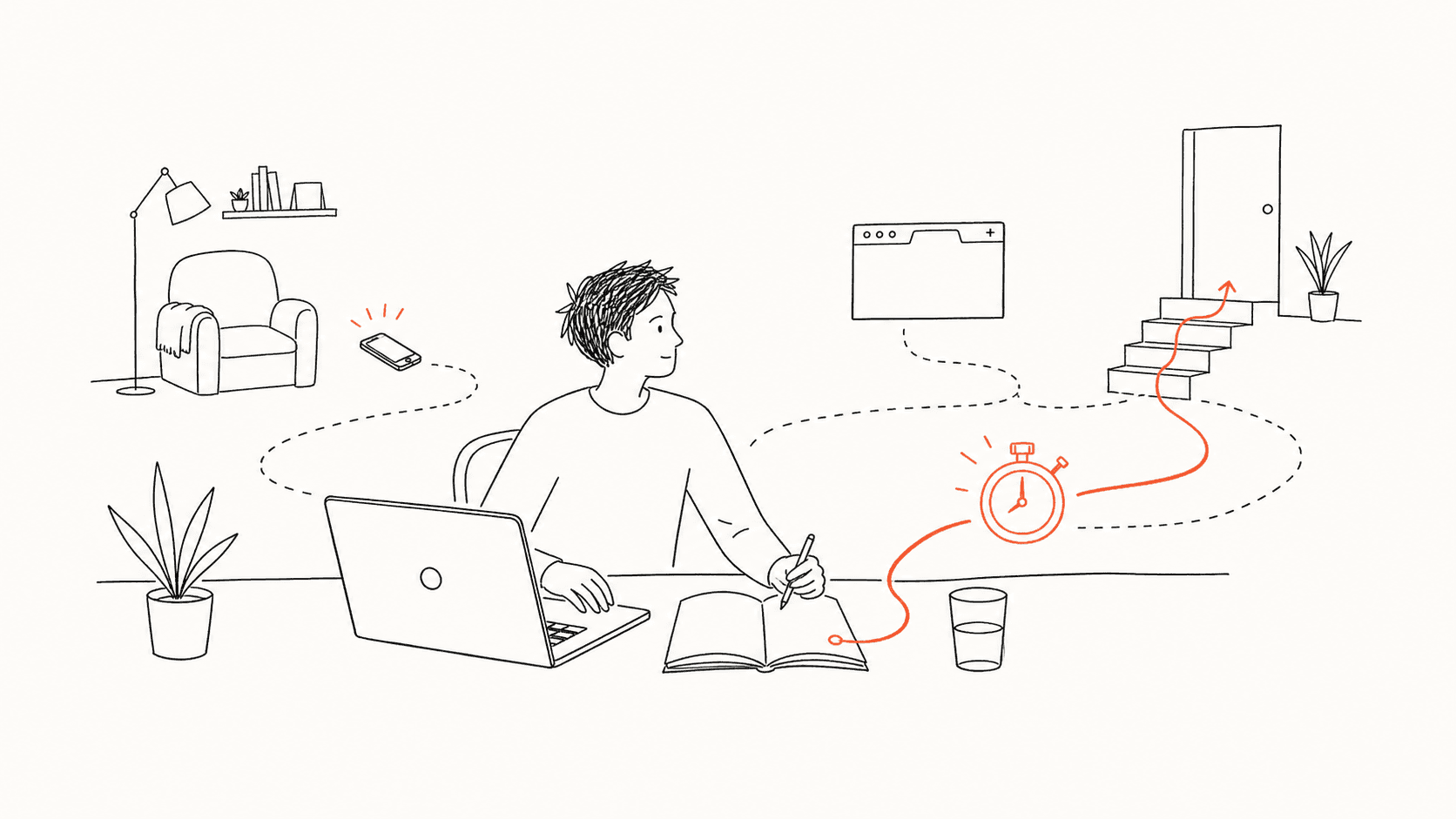
Direct answer
What helps ADHD-style procrastination is not a bigger pep talk. It is a smaller entry point, fewer exits, and a short block you can actually begin.
ADHD is not the center of every stuck moment. Stress, boredom, unclear tasks, anxiety, poor sleep, and phone loops can create similar avoidance. But when task initiation is the pattern, the fix usually starts with the setup around the task.
Why it happens
The task is asking for too many decisions at once.
ADHD-style procrastination often shows up as a strange split: you care about the result, but the task still feels impossible to enter. That usually means the task is not concrete enough yet.
"Work on the application" contains hidden decisions. Which file? Which section? For how long? What counts as a start? What do you do when it gets boring? Until those decisions are removed, the phone or another easier task will feel cleaner.
What helps
Change the doorway into the task.
Turn the task into an entry move.
Do not start with "finish the project." Start with "open the file and write the bad first line" or "put the shoes by the door." The entry move should be too small to debate.
Make the first block short.
Ten to twenty-five minutes is enough. The job of the first block is not to finish. It is to get the task from imaginary to started.
Move the easiest exit away.
If the phone is closer than the task, the phone wins. Put it across the room, close the spare tabs, and make the work the easiest thing to touch first.
Leave a next-start note before you stop.
Stopping without a next move makes tomorrow start from zero. Leave one sentence: "Next: open the outline and fix section two."
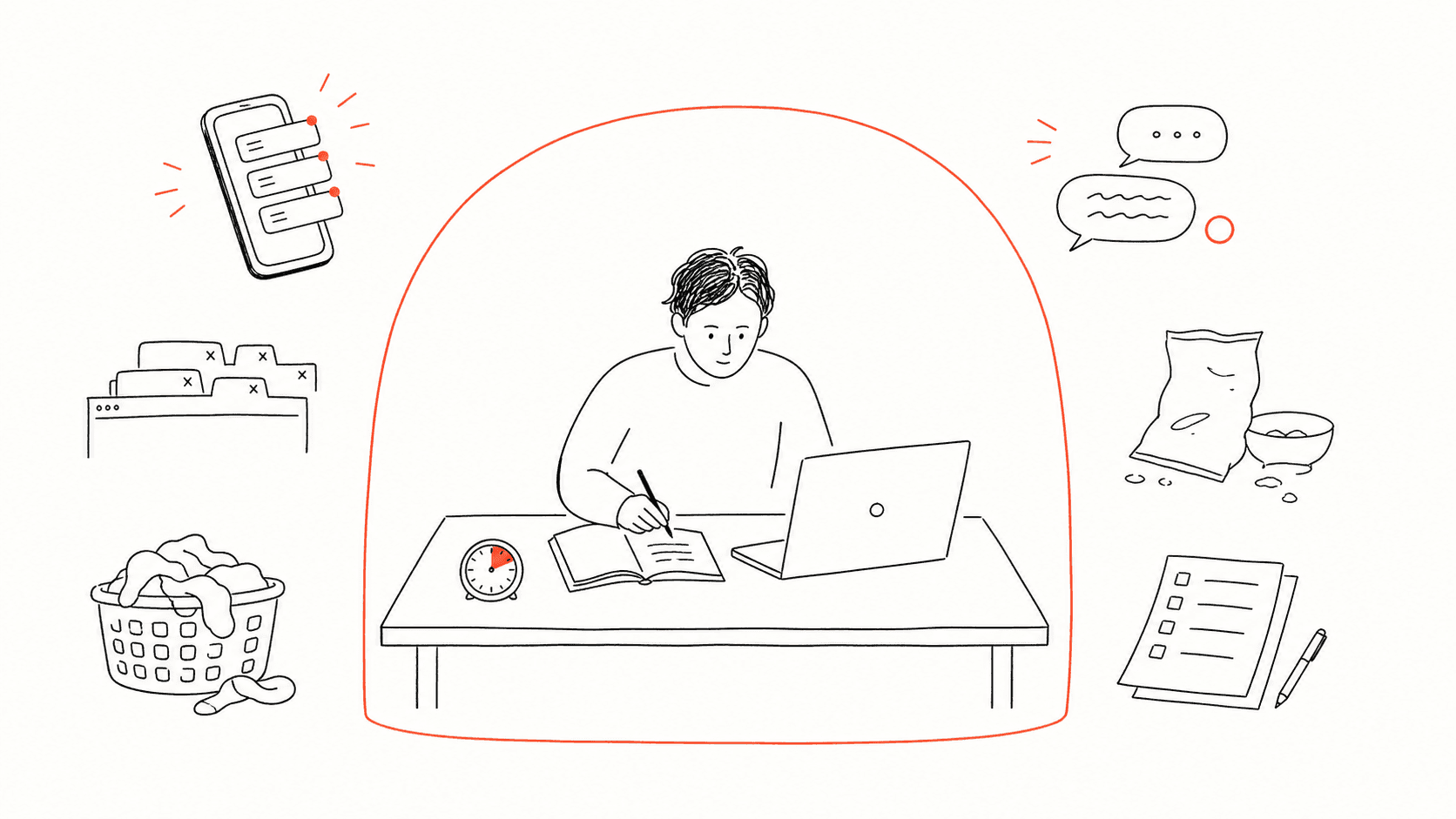
Visual model
Staying focused gets easier when the exits are outside the block.
The goal is not to become immune to distraction. The goal is to make the first block less exposed to it.
Today setup
A 15-minute block that does not rely on mood.
- 1Pick one task you are avoiding, not your whole life.
- 2Write the first physical action, not the outcome.
- 3Move your phone across the room before the block starts.
- 4Set a 15-minute timer and stop when it ends.
- 5Write the next-start note before you leave.
Research notes
The practical angle is setup, not shame.
These notes are used as context, not as medical advice. They support a simple working model: when starting is hard, reduce decisions, lower the first step, and remove the obvious exits.
ADHD can affect starting, organizing, and sustaining attention.
Official ADHD resources describe patterns like distractibility, difficulty organizing tasks, and trouble sustaining attention. This does not diagnose you, but it explains why vague tasks can be unusually expensive to enter.
Procrastination is tied to task aversion and delay.
Piers Steel's meta-analysis links procrastination with task aversiveness, delay, impulsiveness, distractibility, and organization. Translation: the way a task is shaped can raise or lower the cost of starting.
Specific plans beat vague intentions.
Implementation-intention research supports deciding the when, where, and how of action. A concrete first block gives your brain less to negotiate.
Phone placement can matter before you even use it.
Research on smartphone presence found reduced available cognitive capacity in experiments. For this use case, the takeaway is simple: if starting is hard, do not leave the easiest exit within reach.
FAQ
Is ADHD procrastination laziness?
No. Laziness is a moral label, and it usually does not help. The useful question is: what is making the task hard to enter, easy to avoid, or painful to return to?
What helps most when I cannot start?
Shrink the first move until it can be done in under two minutes, then run a short timed block. Starting is easier when the task has an obvious doorway.
Why do I wait until urgency hits?
Urgency can make the next move obvious and raise the cost of avoiding. The problem is that urgency is a rough manager. A small pre-decided block is usually cleaner.
Should I use an app for this?
Only if the app makes the first block easier to start and easier to return to. If it becomes another place to organize forever, it is not helping.
Does this replace treatment or coaching?
No. If ADHD symptoms are interfering with school, work, relationships, or daily life, talk with a qualified healthcare professional.
Diagnostic
Find the exact place your work breaks.
ADHD-style procrastination can break at choosing, starting, staying with it, or checking what happened. The diagnostic gives you the stuck point and one next move.
Find my stuck point